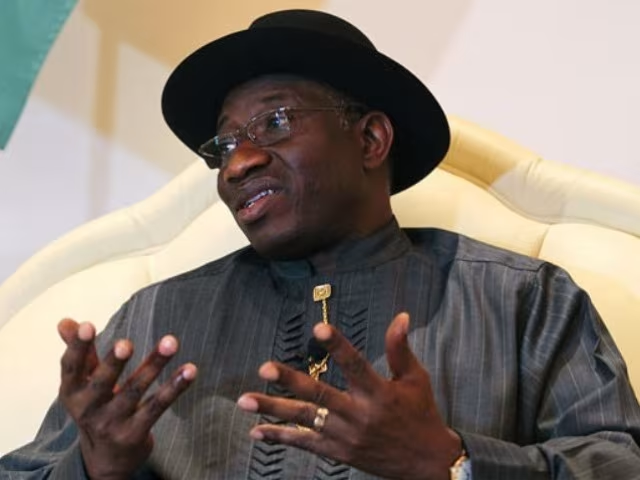
Nigeria’s former President, Goodluck Jonathan, has challenged youth groups urging him to contest the 2027 presidential election to first demonstrate their commitment to democracy by participating in the electoral process.
Speaking on Thursday at his Abuja office, Jonathan addressed delegations of young supporters who appealed to him to seek another term in office.
He emphasized that the presidency is a serious responsibility, famously remarking that the race for Nigeria’s highest office “is not a computer game,” while noting that he would consult widely before making any definitive decisions.
The former president expressed concern over the disconnect between political advocacy and actual voter participation among young Nigerians.
He pointed out that many who push for systemic change fail to secure their Permanent Voter Cards (PVCs), questioning how many of his visitors were even registered to vote. “If I ask how many of you have your voter’s card now, probably 50 percent of you don’t have it,” he stated, insisting that active engagement in the democratic process is a prerequisite for making political demands.
Beyond his personal political future, Jonathan highlighted the broader challenges facing Nigeria’s democratic landscape, specifically citing the country’s consistently low voter turnout.
Drawing from his experience monitoring elections across 14 African nations and parts of Southeast Asia, he described Nigeria’s participation rates as some of the lowest he has observed.
He called on the Independent National Electoral Commission (INEC) to investigate the root causes of this apathy and urged the youth to continue advocating for peaceful, credible, and transparent elections.
The former president also touched upon the international image of Nigeria, lamenting the “disdain” faced by Nigerian youths abroad due to leadership failures at home.
While he acknowledged the growing calls for his return to the Aso Rock Villa, Jonathan remained non-committal, maintaining a cautious stance on the 2027 race.
He reiterated that his next steps would be determined by extensive consultation rather than a hasty reaction to public pressure, stating, “I cannot just wake up and say I want to be the president of Nigeria again.”