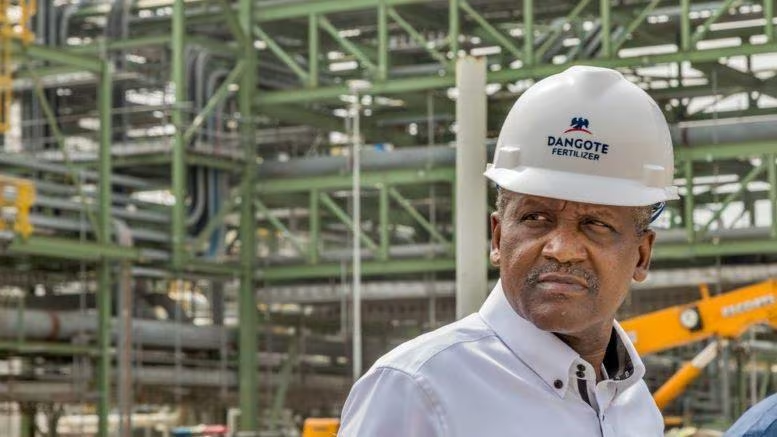
The legal battle for supremacy in Nigeria’s downstream petroleum sector took a dramatic turn as the Dangote Petroleum Refinery dragged the Federal Government to the Federal High Court in Lagos.
The lawsuit challenges the recent decision by the Nigerian Midstream and Downstream Petroleum Regulatory Authority (NMDPRA) to issue fresh fuel import licences to major marketing companies in 2026.
The mega-refinery argues that these new approvals directly violate provisions of the Petroleum Industry Act (PIA), which mandates that fuel importation should only be permitted when domestic production falls short of national demand.
The legal uproar stems from the NMDPRA’s sudden policy U-turn, granting six oil marketing firms—including NIPCO, AA Rano, Matrix Energy, Shafa Energy, Pinnacle Oil and Gas, and Bono Energy—licences to import a combined 600,000 to 720,000 metric tonnes of Premium Motor Spirit (PMS).
This development marks a significant shift from earlier in the year, when the regulator had suspended fresh petrol import permits in February and March on the grounds that domestic refining capacity had improved substantially.
Data shows the Dangote refinery alone had been supplying 36.5 million litres of petrol daily, meeting over 90% of local consumption and driving imports down to a one-year low of three million litres per day.
In a recent interview, the President of the Dangote Group, Aliko Dangote, leveled heavy allegations against what he termed an “oil mafia” determined to sabotage the $20 billion facility.
Speaking with Nicolai Tangen, Chief Executive Officer of Norway’s Sovereign Wealth Fund, Africa’s richest man claimed that entrenched interests, who have grown wealthy off the back of Nigeria’s historical dependence on foreign fuel, view the refinery as a direct threat to their multi-billion naira businesses.
Dangote revealed that opposition to the project had been relentless since its inception in 2013, noting that even land acquisition was delayed for five years by individuals desperate to preserve the status quo.
Reflecting on the deeper systemic issues that motivated him to build the world’s largest single-train refinery, Dangote lamented the absurdity of Nigeria’s 50-year history of fuel queues despite being a major crude producer.
He pointed out that the country’s defunct subsidy regime previously cost nearly $10 billion annually, enriching an exclusive network of international traders, shippers, and local importers at the expense of national foreign reserves. “These are the people that are not agreeing for us to settle down because they believe that we are coming here to displace them,” Dangote stated, adding that despite the enormous costs of building independent infrastructure like ports and water plants, he remained focused on securing Africa’s energy independence.
The unfolding standoff has sharply divided the Nigerian energy sector and sparked intense debate among industry stakeholders.
While some market analysts defend the NMDPRA’s decision, arguing that continuous importation is necessary to foster healthy market competition and ensure absolute supply security, others firmly support with the refinery.
Critics of the new licences warn that unrestricted fuel imports will severely discourage local refining investments, undermine the spirit of the PIA, and ultimately expose Nigeria to a renewed, vulnerable reliance on foreign fuel supplies.