Political tension ahead of the August 15 governorship election in Osun State has escalated significantly following the decision of the Economic and Financial Crimes Commission (EFCC) to place a “Post No Debit” restriction on a state government account domiciled with First Bank.
The state government and Governor Ademola Adeleke’s party swiftly condemned the move as an unconstitutional action and an abuse of due process, arguing that it was executed without a court order to disrupt governance and tilt the electoral playing field.
In its defense, the anti-graft agency maintained that the restriction was strictly a professional measure and entirely devoid of political undertones.
EFCC Head of Media and Publicity, Dele Oyewale, explained that the commission has been investigating the Osun State Government since March 2026 over the alleged fraudulent handling of about N11 billion in Ecology Funds, Intervention Funds, and FAAC allocations.
According to the commission, the action became necessary after detectors flagged precipitate and unwarranted movements of public funds into suspicious corporate accounts beginning August 2.
The development has triggered sharp criticisms from major opposition groups and political parties in the state.
The Accord Party, through its National Chairman Maxwell Mgbudem, described the asset freeze as an act of recklessness and part of a broader federal plot to use state apparatuses to handicap the administration and clear the path for the opposition.
Similarly, the African Democratic Congress (ADC), speaking through its National Publicity Secretary Bolaji Abdullahi, labeled the intervention as political terrorism, warning that choking the state’s finances threatens essential public services, primary healthcare, and workers’ salaries.
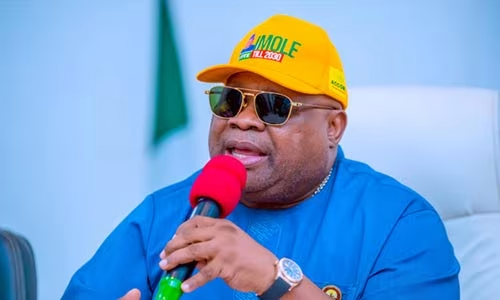
Reacting directly to the development, Governor Adeleke addressed journalists in Osogbo to denounce the directive as a violation of the constitutional rights and autonomy of sub-national governments.
The governor stated that the directive was communicated through their bankers without any legal backing or court order, prompting him to instruct the state Attorney-General to challenge the EFCC’s action at the Federal High Court.
Adeleke maintained that federal regulatory bodies must operate strictly within the boundaries of the rule of law rather than serving as tools for political coercion.
Parallel to the brewing financial controversy, security measures for the impending electoral contest have been ramped up across the state.
The Nigeria Police Force announced a major deployment of 15,000 personnel, encompassing conventional units, the Police Mobile Force, K-9 details, and specialized medical teams to safeguard the peace.
The Commissioner of Police in charge of election security, Samuel Erale Etaifo, warned politicians and stakeholders against undermining the polls, noting that any electoral law violators would be arrested and immediately transferred to Abuja for prosecution.
As the August 15 showdown draws closer, the convergence of the legal battle over the frozen accounts, fierce partisan rhetoric, and intensified security deployments has set a high-stakes tone for the state.
Both state authorities and federal agencies remain locked in a battle of narratives, leaving voters and observers closely monitoring how the financial restriction and security framework will impact the democratic exercise.