

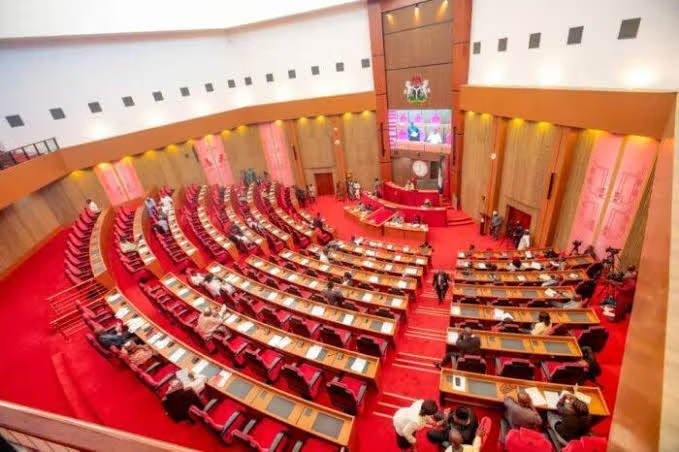
In a historic legislative shift, the Senate on Wednesday passed the landmark Constitution Alteration Bill seeking to establish state police across Nigeria.
The passage marks a monumental step in the nation’s decades-long debate over decentralizing its security architecture to combat worsening nationwide insecurity.
The decisive breakthrough followed a rigorous, clause-by-clause consideration of the bill, culminating in a final vote where more than two-thirds of the upper chamber overwhelmingly backed the proposal.
Senate President, Godswill Akpabio, officially announced the passage of the legislation after lawmakers adopted the report presented by the Deputy Senate President and Chairman of the Committee on the Review of the Constitution, Barau Jibrin.
Led in debate by Senate Leader Opeyemi Bamidele, the legislation aims to dismantle the federal government’s exclusive control over policing by creating a state-led framework that will operate concurrently with the existing federal structure.
Under the newly approved provisions, state governors will be empowered to appoint their respective Commissioners of Police, subject to confirmation by State Houses of Assembly.
While the Federal Police Service will remain under the command of the Inspector-General of Police, the bill grants governors the authority to issue lawful, written directives to state commissioners regarding public safety and order.
Key Provision — Clause 17: > While the Federal Police Service will continue to be headed by the Inspector-General of Police, each State Police Service shall be headed by a Commissioner of Police appointed by the governor and confirmed by the legislature of the state.
To assuage long-standing fears regarding the potential weaponization of local law enforcement by powerful politicians, lawmakers integrated stringent safeguards into the bill.
Section 17(7) explicitly bars State Commissioners of Police from arresting, detaining, or deploying force against any individual, group, or political party simply for criticizing the government.
This crucial clause is explicitly designed to safeguard civil liberties, political freedoms, and dissenting voices, ensuring all state-level police actions comply strictly with due process and existing constitutional laws.
The historic vote itself was marked by a sudden procedural shift when the Senate abandoned plans to use an electronic voting system just an hour before the session.
Citing fears that technical glitches on some devices could disenfranchise lawmakers and compromise the integrity of the exercise, the Senate adopted a manual, open-ballot system following a motion by Senator Bamidele.
Backed by Senate President Akpabio to promote maximum transparency, senators were called upon individually to declare their stance.
The high-stakes proceedings were watched from the gallery by several high-ranking officials, including the Chief of Staff to the President, Femi Gbajabiamila, and the governors of Kaduna, Ogun, and Ondo states.
As one of the most consequential constitutional reforms undertaken by the 10th National Assembly, the bill now moves closer to reality but still faces further rigorous legal hurdles.
While proponents argue that a decentralized force is desperately needed to tackle rampant banditry, terrorism, and kidnapping, critics remain wary of potential executive overreach by state governors.
To become law, the proposal must now secure the required concurrent approval from the House of Representatives and at least two-thirds of the State Houses of Assembly across the federation.