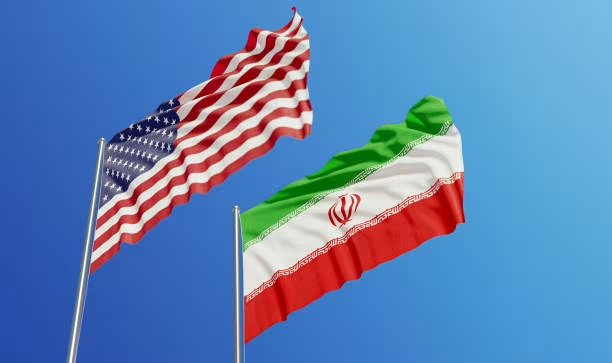
A historic breakthrough has emerged in the effort to end the devastating conflict in the Middle East, with a landmark deal between the United States and Iran scheduled to be signed this Friday, June 19.
The Swiss foreign ministry confirmed that the ceremony will take place at the highly secure, ultra-luxury Bürgenstock resort, perched overlooking Lake Lucerne.
This development follows a joint announcement by Washington and Tehran declaring they have established a memorandum of understanding to halt the warfare that has engulfed the region since erupting late last winter.
The conflict began on February 28 following a series of coordinated U.S. and Israeli airstrikes on Iranian targets, rapidly spiraling into a broader regional war.
Weeks of high-stakes, fraught negotiations and persistent threats of renewed hostilities followed. The breakthrough was finally achieved through intensive diplomatic efforts spearheaded by Pakistani and Qatari mediators, who alongside the warring parties, selected the secluded Swiss resort for its strategic, easily securable geography.
While the physical signing ceremony is set for Friday, a senior U.S. official revealed that the framework agreement has already been electronically signed by top leadership.
Signatories include U.S. President, Donald Trump, Vice President, JD Vance, and Iran’s top negotiator and deputy foreign minister, Mohammad Bagher Ghalibaf.
Swiss authorities emphasized that their role has been strictly facilitative, focusing on providing the secure practical and diplomatic environment necessary to finalize the accord.
Despite the breakthrough, considerable skepticism remains as the official text of the agreement has not yet been made public.
Significant ambiguity surrounds how the two nations resolved bitter disputes regarding Iran’s nuclear program, international economic sanctions, and maritime security in the vital Strait of Hormuz.
Underscoring the preliminary nature of the breakthrough, Vice President Vance noted to CNN that the framework is “about a page and a half, so it is a very general document,” leaving observers to question how much detailed groundwork is left to be laid.