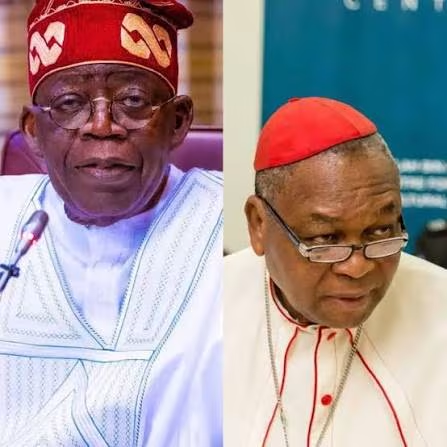
The Northern Christian Association (NCA), alongside former Vice President Atiku Abubakar and Senator Shehu Sani, has strongly defended the Catholic Bishops Conference of Nigeria (CBCN) following fierce attacks from the presidency.
The controversy erupted after former Archbishop of Abuja, John Cardinal Onaiyekan, criticized President Bola Tinubu’s administration in a television interview, accusing it of growing intolerant of dissent, failing to grasp the severity of economic hardships, and allegedly plotting to win the 2027 elections by all means.
In response, Presidential Spokesperson Daniel Bwala dismissed the Cardinal’s remarks as politically motivated, claiming he spoke only for Catholics rather than all Christians and labeling him as more political than spiritual.
Reacting sharply to Bwala’s comments, NCA Chairman, Rev. Joseph Hayab, accused the presidential aide of attempting to sow discord within the Christian community through divisive politics.
Hayab emphasized that the association encompasses diverse Northern Christian denominations—including Baptists, ECWA, Methodists, Anglicans, and Pentecostals—and stated that Catholics are an integral part of the Nigerian body of Christ.
Describing Bwala’s verbal attacks as “shameful and a disservice” to President Tinubu, the cleric maintained that the bishops went to Aso Villa to advocate for humanity and the broader citizenry, warning that government appointees relying on propaganda over reality are destroying the country for selfish interests.
Weighing in on the escalating row, Atiku Abubakar asserted that the presidency opted for intimidation and political attacks instead of reflecting on the substance of the truth delivered by the clerics.
In a statement issued through his media office, the opposition figure accused the administration of surrounding itself with compliant figures, contrasting it with the independent and moral authority of the Catholic Church.
Atiku argued that a government confident in its track record would welcome constructive feedback rather than waging war on honest voices, and he demanded a formal apology from the presidency to the Catholic community and Cardinal Onaiyekan.
Adding his voice to the defense, former Kaduna Central Senator, Shehu Sani, noted that the Catholic Bishops have a proud, non-partisan history of speaking truth to successive Nigerian governments dating back to the military era.
Writing on his X handle, Sani remarked that the bishops have never been sycophantic in their dealings with the political elite, metaphorically noting that they traditionally present leaders with bitter kola rather than olive oil during state visits.
This long-standing tradition of moral oversight, according to political observers, underscores the weight of the clergy’s interventions on national governance.
The widening rift highlights deep-seated tensions between the current administration and prominent religious institutions over Nigeria’s worsening socio-economic conditions, marked by widespread poverty, hunger, and inflation.
While the presidency maintains that its reforms are necessary and that critiques are politically driven, civil and religious leaders insist that governance must be anchored on empathy and transparency.
As the political landscape heats up toward future electoral cycles, analysts warn that dismissing legitimate grievances from moral authorities could further alienate citizens grappling with daily survival.