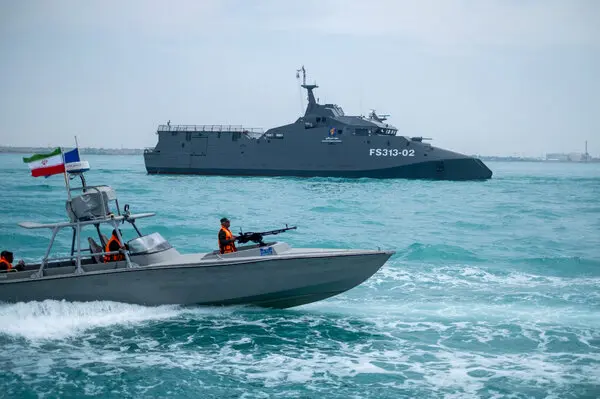
The United States and Iran traded intense military strikes for a second consecutive day on Wednesday, as a violent battle for control over the strategic Strait of Hormuz threatens to plunge the region deeper into conflict.
The vital oil and gas corridor has become the central flashpoint in a wider Middle East war that erupted in February.
While Washington demands unhindered free passage through the waterway, Tehran is fiercely insisting on regulating the strait, imposing transit fees, and targeting vessels that deviate from its authorized routes.
The latest escalation followed a declaration by U.S. President Donald Trump that a month-old ceasefire with Iran was officially “over.”
Trump’s remarks came after Iranian forces allegedly struck three commercial ships in recent days. In retaliation, the U.S. Central Command (CENTCOM) launched a massive wave of aerial assaults, striking approximately 90 military targets along Iran’s coastline, including drone and missile storage facilities and military logistics sites.
Iranian state media reported that the U.S. strikes hit a railway bridge in the northeast, a military base in coastal Bushehr, and areas near the southwestern city of Ahvaz, resulting in at least three deaths.
Iran’s Islamic Revolutionary Guard Corps (IRGC) retaliated swiftly, launching one-way attack drones and missiles at key U.S. military infrastructure across the Gulf.
Explosions and interceptions were reported in Bahrain and Kuwait, with Tehran claiming successful hits on American bases in Arifjan, Ali Al Salem, Juffair, and Sheikh Isa, as well as sites in Qatar.
This heavy exchange occurred under a backdrop of immense domestic gravity for Iran, coming just hours ahead of the burial of Ali Khamenei, the country’s late Supreme Leader who was killed at the outbreak of the war on February 28.
On the diplomatic front, rhetoric remained fiercely combative despite behind-the-scenes maneuvering. President Trump claimed on Truth Social that the operations were direct retribution for Iran’s maritime bombings, warning that future provocations would get “much worse,” though he later noted aboard Air Force One that Iranian officials had reached out wanting to “make a deal.”
Conversely, Iran’s chief negotiator, Mohammad Bagher Ghalibaf, defiantly postured on social media, asserting that the Strait of Hormuz would only operate under “Iranian arrangements” and warning Washington that “if you strike, you will be struck.”
The escalating warfare has sent shockwaves through international maritime commerce and neighboring Gulf states.
Oman, which shares the strait with Iran, has desperately attempted to maintain its neutrality by proposing a temporary transit corridor hugging its coastline, though Iran has rejected allowing vessels to pass freely through Omani waters.
With maritime traffic paralyzed yet again, International Maritime Organization chief Arsenio Dominguez confirmed that nearly 6,000 seafarers remain stranded in the volatile zone, as UN Chief Antonio Guterres and regional mediators like Pakistan issue urgent appeals for maximum restraint.