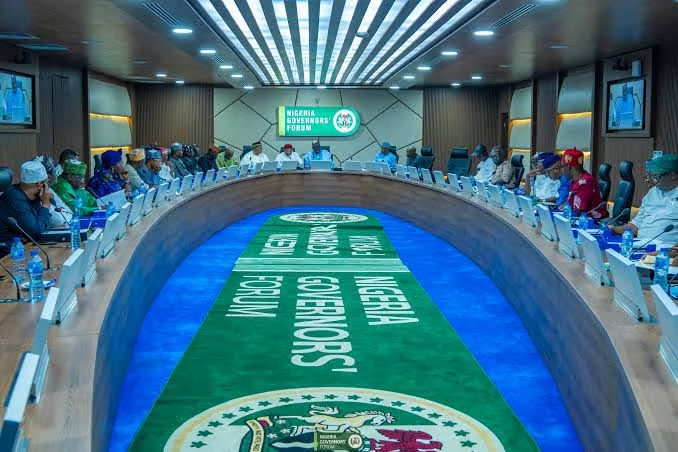
The 36 state governors of the federation, operating under the aegis of the Nigeria Governors’ Forum (NGF), have reaffirmed their strong support for the immediate establishment of state police, insisting that the framework must be constitutionally sound and aligned with the principles of federalism and citizens’ rights.
This collective stance follows significant legislative momentum in the National Assembly, where a constitutional amendment bill to decentralize policing overwhelmingly scaled its second reading in the Senate and secured the backing of 289 out of 290 lawmakers present during a recent plenary session in the House of Representatives.
Rising from their meeting in Abuja, the governors disclosed in a communique signed by NGF Chairman and Kwara State Governor, AbdulRahman AbdulRazaq, that they have received comprehensive briefings from the Forum’s Secretariat and a delegation of State Attorneys-General.
The proposed legal framework establishes two distinct tiers—the Federal Police and State Police—with explicit provisions that state forces must meet national minimum standards before commencing operations.
Notably, the bill includes robust safeguards against federal overreach, strictly prohibiting the Federal Police from interfering in a state’s internal security affairs unless explicitly requested by a governor or necessitated by a total breakdown of law and order.
Under the blueprint of the proposed constitutional amendment, the administrative and command structures will be highly localized yet stringently monitored.
A State Police force will be headed by a Commissioner of Police appointed by the Governor on the advice of the restructured National Police Council, subject to confirmation by the State House of Assembly.
To maintain strict accountability and institutional checks, top police officials can only be removed through a two-thirds majority vote of the respective legislature on specified grounds of misconduct, while funding will be reinforced through dedicated federal grants alongside state resources.
In addition to security, the governors reiterated their commitment to critical infrastructure, formally endorsing the National Solar Super-Grid (NSSG) initiative.
Presented in a communique read by Ogun State Governor, Dapo Abiodun, the NSSG project aims to drastically expand electricity access across Nigeria through large-scale, decentralized solar generation integrated with the national high-voltage transmission network.
The Forum emphasized that the initiative holds immense potential to drive regional industrialization, fortify energy security, and accelerate the development of independent state electricity markets.
On the human development front, the NGF pledged its total alignment with the federal government’s National Nutrition 774 (N-774) Initiative, reaffirming a shared commitment to reversing child malnutrition trends across all local government areas.
To sustain these gains, the governors welcomed a briefing from the World Bank Country Office regarding the Country Partnership Framework for Nigeria (FY2026–2032) and the Sustainable Agricultural Value-Chains for Growth (AGROW) programme.
The forum approved state-specific interventions and stressed the vital importance of multi-sectoral coordination across health, education, and agricultural sectors to maximize the impact of these development programmes.