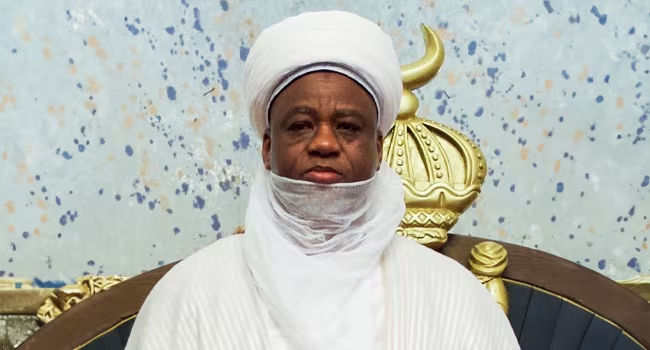
The Sultan of Sokoto, Sa’ad Abubakar III, has strongly dismissed fears of a coordinated religious agenda in Nigeria, asserting that Muslims have no plans to “decimate” or displace the Christian population.
Speaking on Wednesday at the first triannual meeting of the Nigeria Inter-Religious Council (NIREC) in Abuja, the Sultan pushed back against deepening suspicions, describing much of the country’s violence as being fundamentally misunderstood.
He emphasized that the path to peace lies in absolute coexistence, noting that it is impossible for either faith to remove the other from the nation’s fabric.
Addressing the labels often attached to insecurity, the Sultan urged Nigerians to stop attributing criminal acts to religion, arguing that “Muslim terrorists” or “Muslim bandits” are contradictions in terms.
He clarified that those who commit acts of violence while invoking the name of God are acting against the core tenets of Islam and will “suffer for taking innocent lives.”
The Sultan linked the rise of extremism to a lack of genuine religious literacy, warning that mere proficiency in Arabic does not grant religious authority and that ignorance has fueled the current cycle of mistrust.
Echoing these sentiments, the President of the Christian Association of Nigeria (CAN), Archbishop Daniel Okoh, advocated for a “reset” in how Nigerians perceive conflict.
He noted that many tensions are wrongly framed as religious disputes when their root causes are actually social, economic, or political.
Okoh called for the cultivation of religious literacy—not just as an academic exercise, but as a tool for empathy—stressing that NIREC continues to prove that shared values of justice and the dignity of human life can transcend sectarian divides.
The Secretary to the Government of the Federation (SGF), George Akume, further tied this understanding to national stability, calling on educational institutions to prioritize accurate and inclusive teaching about various worldviews.
Akume challenged Nigerians to resist divisive narratives and pledged the government’s commitment to ending the targeting of students by terrorists.
The council concluded that the only workable path forward for the country is through consistent dialogue and the rebuilding of trust between faith communities to ensure a stable and respectful environment for all.