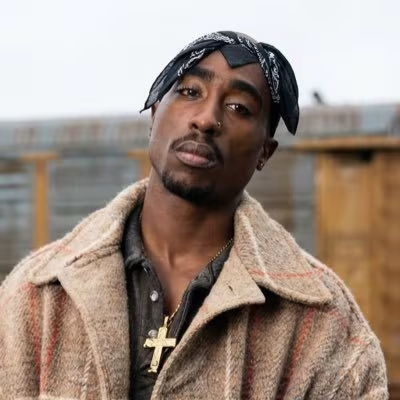
The decades-old murder of legendary rapper Tupac Shakur reaches a critical milestone as a former gang leader goes on trial in Las Vegas.
The high-profile proceedings are expected to last roughly a month, centering on the fateful night of September 7, 1996, when Shakur was gunned down in a drive-by shooting following a Mike Tyson boxing match in Sin City.
While prosecutors concede the trial may not definitively reveal who pulled the trigger, their core objective is to prove that Duane “Keffe D” Davis, the 63-year-old onetime leader of the South Side Compton Crips, orchestrated the assassination and supplied the weapon.
Davis faces a sentence of life in prison without parole if convicted.
The enduring mystery of Shakur’s death remains one of America’s most celebrated cold cases, steeped in the bitter East Coast-West Coast hip-hop rivalry of the 1990s.
Shakur, who died at age 25, was signed to Los Angeles-based Death Row Records—founded by Marion “Suge” Knight and reportedly protected by the Mob Piru gang—while rival Bad Boy Records, featuring Christopher “The Notorious B.I.G.” Wallace, employed Davis’s Compton Crips as security.
According to prosecutors, tensions boiled over after the Tyson fight at the MGM Grand casino when Shakur and Knight assaulted Davis’s nephew, Orlando “Baby Lane” Anderson, prompting Davis to seek violent retribution.
For decades, the investigation stalled due to a severe lack of cooperating witnesses and physical evidence.
However, the cold case dramatically re-opened following the 2019 publication of Davis’s memoirs, in which he openly admitted to being in the front seat of the white Cadillac from which the shots were fired and handing a pistol to the back seat.
Although everyone else in the vehicle that night has since passed away, Davis’s own words—echoing previous statements he made to reporters and police—came back to haunt him, leading to his dramatic arrest in September 2023.
Davis has since pleaded not guilty and aggressively backtracked on his confessions, claiming in a 2025 prison interview that he never killed anyone and was actually in Los Angeles the night of the shooting.
He asserted that his memoirs were heavily inflated by his co-author for book sales and that he never even read the final product.
Ahead of the trial, defense attorneys unsuccessfully fought to block both the book and a 2008 police interview from being admitted as evidence, setting the stage for a contentious legal battle that begins with a week of jury selection.
Regardless of the verdict, the trial is unlikely to fully satisfy those closest to the iconic artist, as questions regarding broader conspiracies persist.
In May, the rapper’s stepbrother, Maurice Shakur, filed a civil wrongful death lawsuit emphasizing that multiple individuals involved in the murder have eluded accountability for three decades.
The civil complaint notably references a documentary series, “Sean Combs: The Reckoning,” in which police interview footage features Davis claiming that Sean “Diddy” Combs offered him $1 million to carry out the high-profile hit.