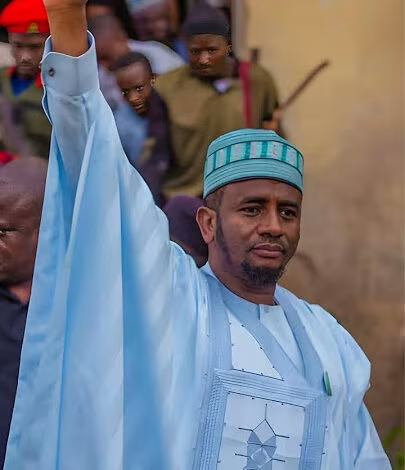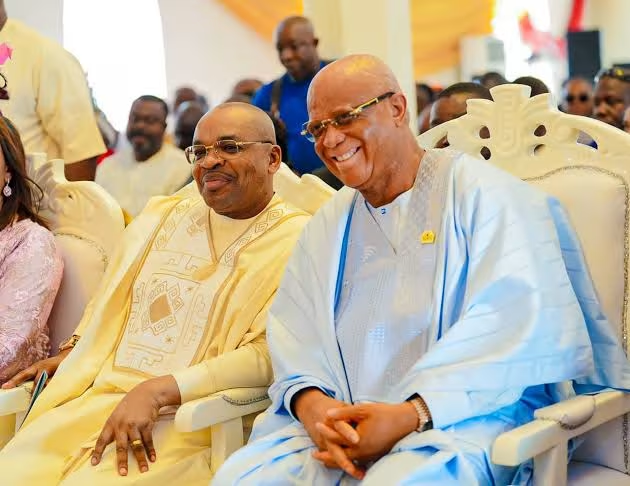
Former Vice President, Atiku Abubakar, has emerged as the presidential candidate of the African Democratic Congress (ADC) for the 2027 general election after securing a landslide victory in the party’s primary election.
Atiku defeated former Minister of Transportation, Rotimi Amaechi, and businessman, Mohammed Hayatu-Deen, to clinch the party’s ticket.
The result was officially announced on Wednesday night through a statement shared on the ADC’s official X account.
According to the final results released by the party, Atiku polled 1,855,787 votes to defeat Amaechi, who secured 509,397 votes, while Hayatu-Deen garnered 180,903 votes.
A total of 2,546,457 votes were cast out of the party’s 3,113,599 registered members eligible to participate in the exercise.
The wide margin of victory further cemented Atiku’s dominance in the contest and confirmed his position as the ADC’s standard-bearer for the next presidential election.
Speaking shortly after his victory at the Transcorp Hilton in Abuja, Atiku described the outcome as proof that democracy remains alive within the ADC despite what he called increasing pressure on opposition parties by the ruling All Progressives Congress (APC).
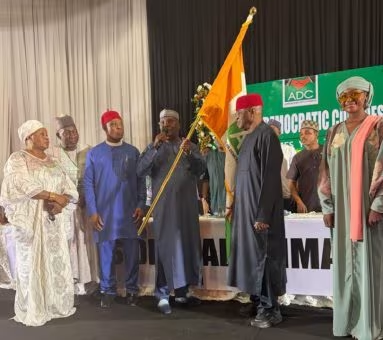
He accused the APC-led administration of using security agencies, the Independent National Electoral Commission (INEC), and elements within the judiciary to destabilize opposition parties across the country.
He also condemned the detention of former Kaduna State Governor, Nasir El-Rufai, describing it as part of a wider clampdown on opposition figures.
The ADC flagbearer urged his opponents and party members to unite ahead of the 2027 election, insisting that the coalition could not afford internal divisions.
He specifically appealed to Rotimi Amaechi and Mohammed Hayatu-Deen to join him in what he described as a struggle to save Nigeria’s democracy.
Atiku stressed that the primary contest should not be seen as a battle with winners and losers, but as a collective effort to build a stronger opposition capable of challenging the ruling party.
Addressing national issues, Atiku criticized the Tinubu administration over worsening insecurity, economic hardship, education challenges, and the healthcare sector.
He alleged that anti-corruption agencies were being used to pressure opposition politicians into joining the APC and accused the government of failing to tackle rising poverty and violence across the country.
Promising reforms if elected, Atiku pledged to strengthen security institutions, provide free and compulsory education at primary and secondary levels, and invest heavily in healthcare infrastructure.
He also vowed to replace what he described as the APC’s “meaningless renewed hope” with “renewed action” aimed at rebuilding Nigeria’s economy and democratic institutions.