
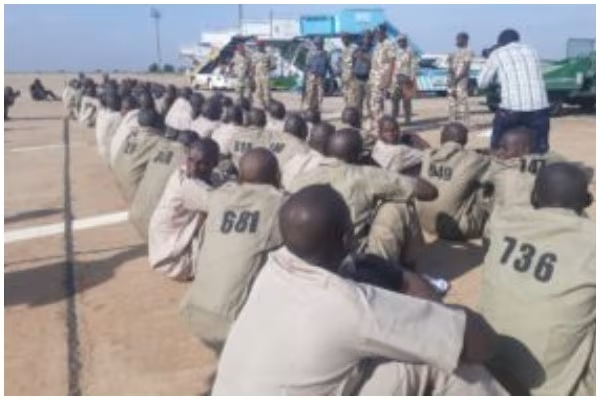
The Borno State Government has moved to address mounting public anxiety regarding the potential for rehabilitated former terrorists to rejoin insurgent groups.
Addressing concerns over the efficacy of the state’s deradicalization and reintegration initiative, officials emphasized that the program includes rigorous safeguards designed to ensure that those who have surrendered do not return to the battlefield.
Central to these safeguards is a spiritual mandate; the Commissioner for Women Affairs and Social Development, Zuwaira Gambo, revealed that the final stage of the “Borno Model” involves beneficiaries swearing an oath on the Holy Quran.
Gambo explained that this act carries immense weight, noting that the spiritual consequences of breaking such an oath serve as a powerful deterrent.
Furthermore, she argued that even if an individual attempted to return to the “bush,” they would likely be treated as “infidels” and targeted by their former comrades, effectively making them “dead on arrival.”
Despite these assurances, the program continues to face logistical and financial hurdles. Gambo highlighted that inadequate funding remains a primary obstacle, complicating the government’s ability to provide essential services such as food, clothing, and education for the high volume of participants.
These resource gaps have raised questions about the long-term sustainability of the rehabilitation process as the state continues to manage thousands of former associates of insurgent groups.
The debate has intensified following the recent graduation of 744 former insurgents under the Federal Government’s “Operation Safe Corridor.” Critics and stakeholders have expressed skepticism regarding the transparency of the vetting process.
Isa Sanusi, Country Director of Amnesty International Nigeria, argued that the government must provide more clarity on the background of these “repentant” individuals—distinguishing between low-level informants and active combatants—to build public trust and ensure accountability.
Legal and human rights advocates are also calling for a more victim-centric approach to reintegration. Nigerian Bar Association President, Afam Osigwe, cautioned that reintegrating perpetrators without addressing the trauma and losses of their victims could be perceived as rewarding criminality.
As the program moves forward, the Borno State Government faces the delicate challenge of balancing the necessity of peacebuilding with the demands for justice and the reality of a constrained budget.