
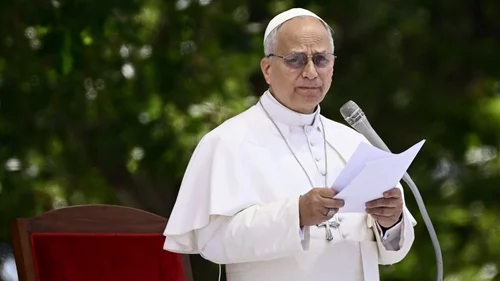
Pope Leo XIV will release his highly anticipated encyclical on artificial intelligence, titled “Magnifica Humanitas” (Magnificent Humanity), on Monday.
In a historic first for the Catholic Church, the American pontiff will attend the Vatican presentation in person, signaling the profound importance of the document.
The manifesto represents a major bid by the Holy See to address the escalating ethical and social challenges posed by rapid global technological development, positioning the issue as a central cornerstone of Leo’s one-year-old papacy.
Reflecting a modern approach to the issue, the Pope will be joined at the presentation by Vatican officials and key tech industry leaders, including the co-founder of American AI startup Anthropic.
The company is currently embroiled in a high-profile legal battle with the U.S. military after refusing to alter internal policies that prohibit its Claude model from being used in mass surveillance or lethal autonomous warfare.
Pope Leo has fiercely critiqued the militarization of AI, warning that delegating life-and-death decisions to machines triggers a “destructive spiral,” while additionally condemning the “environmental devastation” driven by the frenzied race for rare earth elements.
The landmark document aims to guide humanity through a staggering technological boom, with the UN estimating the AI market could skyrocket to $4.8 trillion by 2033 while dangerously concentrating wealth.
Signed on the 135th anniversary of Pope Leo XIII’s foundational 1891 social doctrine on the Industrial Revolution, “Magnifica Humanitas” is being viewed by experts as a modern parallel.
Vatican officials and academics emphasize that just as the Church responded to the labor and power shifts of the industrial era, it must now issue a civilizational “wake-up call” to ensure human dignity is protected in the algorithmic age.
This encyclical builds on years of Vatican study, including the 2020 “Rome Appeal for an AI Ethic” and extensive warnings from the Pope’s predecessor, Pope Francis.
Since taking office, Pope Leo XIV has consistently sounded the alarm over AI’s lack of algorithmic transparency, its capacity to fuel societal polarization, and the dangerous “gradual replacement of reality by its simulation.”
Experts predict the new text could mirror the global political and civic impact of Pope Francis’s 2015 climate change manifesto, Laudato Si’, by fundamentally shaping international debate around digital literacy and tech regulation.