
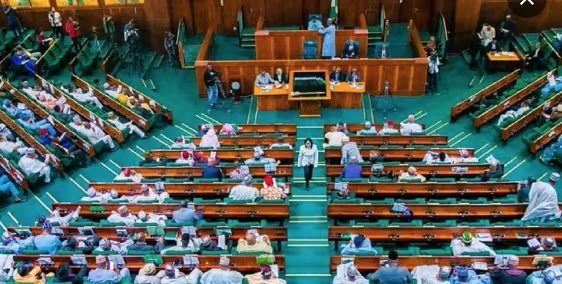
The House of Representatives on Thursday passed a landmark constitutional amendment bill to establish state police nationwide, marking a significant milestone in Nigeria’s decades-long debate over decentralizing policing.
Titled the “Sixth Alteration Bill, 2026,” the legislative measure was approved during a session of the Committee of the Whole, presided over by the Speaker of the House, Rt. Hon. Tajudeen Abbas.
The move follows years of intense public discourse regarding the centralization of security forces amid escalating internal security challenges.
The passage followed a presentation by the Deputy Speaker and Chairman of the House Committee on Constitution Review, Hon. Benjamin Kalu, who strongly canvassed support for a decentralized policing framework.
Lawmakers subsequently conducted a manual vote, raising their hands to register their positions. The result demonstrated overwhelming bipartisan backing for the reform, with 289 members voting in favour of the bill, one member abstaining, and zero votes cast against it.
Under the proposed amendment to Section 214 of the 1999 Constitution, Nigeria’s security architecture will be fundamentally restructured to accommodate both Federal and State Police formations.
The National Assembly will retain the authority to prescribe the overarching structure and minimum operational standards for these forces.
To ensure a regulated transition, the bill stipulates that no state police formation can commence operations without enabling legislation from its respective State House of Assembly and certification from the federal government, leaving the Federal Police in control until those conditions are met.
The bill also introduces stringent safeguards to limit federal interference while establishing a localized command structure.
Under the amended framework, the Federal Police can only intervene in a state’s internal security during a complete breakdown of law and order, upon a governor’s request, or if the state force suffers severe operational failure.
Furthermore, State Commissioners of Police will be appointed by governors on the advice of the Nigeria Police Council, subject to confirmation by the local legislature.
Governors will hold the power to issue lawful security directives, though commissioners can appeal disputed orders to the Nigeria Police Council for a final decision.
Representing one of the most comprehensive security reforms contemplated since the return to democratic rule in 1999, the bill now proceeds to the Senate for concurrence.
To successfully alter the constitution, the piece of legislation must also secure endorsements from at least two-thirds of the State Houses of Assembly and receive presidential assent.
If fully enacted, the law will usher in a new era of multi-layered policing aimed at tackling banditry, terrorism, and kidnapping through a localized security architecture.