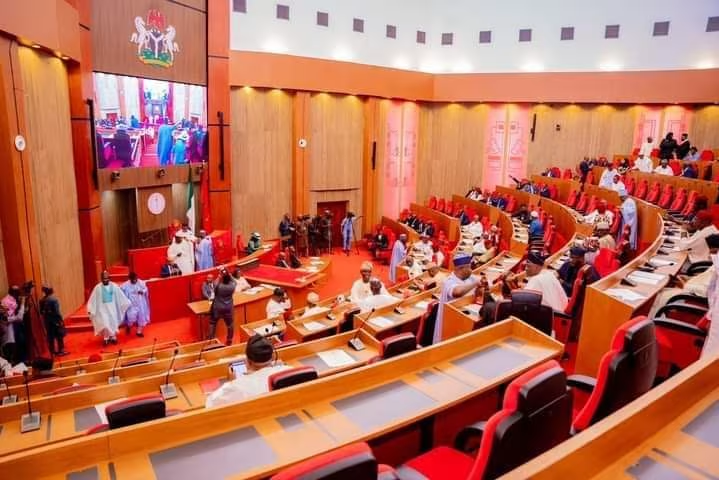
In a major legislative stride toward reshaping Nigeria’s internal security framework, a pivotal bill seeking to establish state police and decentralize law enforcement powers passed its second reading in the Senate.
Titled “A Bill for an Act to Alter the Constitution of the Federal Republic of Nigeria, 1999 (Sixth Alteration), 2026 (SB. 794),” the legislation was sponsored by Senate Leader, Senator Opeyemi Bamidele (APC, Ekiti Central).
Following a robust debate that garnered widespread, cross-party support, Senate President, Godswill Akpabio, referred the bill to the Senate Ad-hoc Committee on the Review of the 1999 Constitution, chaired by Deputy Senate President, Jibrin Barau, for further scrutiny.

Leading the debate, Senator Bamidele argued that the country’s worsening security challenges—ranging from terrorism and mass abductions to banditry and cybercrime—necessitated an urgent overhaul of the current centralized policing system.
He noted that the existing federal structure has struggled to effectively counter highly localized threats, prompting a sustained national outcry for decentralized policing.
By shifting policing powers from the Exclusive Legislative List to the Concurrent Legislative List, the bill aims to modernize Nigeria’s security architecture and foster true cooperative federalism.
To ensure accountability and mitigate the risks of political abuse by subnational authorities, the proposed legislation outlines a balanced, multi-layered system.
Bamidele emphasized that the reform is designed to strengthen, rather than weaken, national unity by establishing distinct federal and state police structures with clearly defined boundaries.
The framework introduces stringent federal oversight mechanisms, uniform national standards, legislative confirmation for top police appointments, and the creation of State Police Service Commissions to maintain independent checks and balances.
Furthermore, the bill includes critical constitutional safeguards, including explicit provisions that grant the federal government the power to intervene in the event of a total breakdown of law and order within any state.
Proponents argue that localized policing will drastically improve response times, boost community trust, and enhance intelligence gathering.
This shift would also relieve the Federal Police of local burdens, enabling them to focus exclusively on interstate crimes, counter-terrorism, border security, and the protection of critical federal assets.
The bill received strong backing from lawmakers across the federation, including notable support from northern senators who viewed it as a viable, long-term solution to regional insecurity.
Adding his voice to the debate, Senate Chief Whip, Senator Tahir Monguno (APC, Borno North), noted that the legislation would effectively regulate and absorb the various vigilante groups currently operating across the country.
By bringing these informal security outfits under a structured legal framework, the bill ensures proper accountability and training, marking a decisive step forward in the nation’s legislative journey.